Written By: McKenna Crisp, M.S R-SLP
Registered Speech Language Pathologist
Have you ever asked your child, “Do you want an apple or an orange?” only to hear them repeat, “An apple or an orange?” right back to you?
You might wonder why your child is repeating your words rather than answering your question. For some children, this may be an example of gestalt language processing, a way of learning and using language that often involves familiar phrases or longer chunks of language.
In this blog, we’ll explore what gestalt language processing is, how it may look in everyday life, and how you can support your child’s communication development at home.
The Difference Between a Gestalt Language Processor, vs an Analytic Language Processor
Children develop language in different ways. Two commonly discussed approaches to language learning are analytic language processing and gestalt language processing.
Analytic Language Processor:
Children who learn language analytically often begin with individual words, gradually combining them into short phrases and longer sentences.
For example:
“Monkey”
“Big monkey”
“Big monkey jumping”
“The big monkey is jumping!”
This is a familiar way of understanding language development: children learn individual words and build on them to communicate increasingly complex ideas.
Gestalt Language Processor:
Children who use gestalt language processing may initially learn language in larger chunks, such as familiar phrases, sentences, or expressions they have heard from other people, songs, books, or videos. These chunks are sometimes called gestalts or scripts.
Over time, a child may begin to break these longer phrases into smaller, more flexible units and combine them in new ways to express their own ideas.
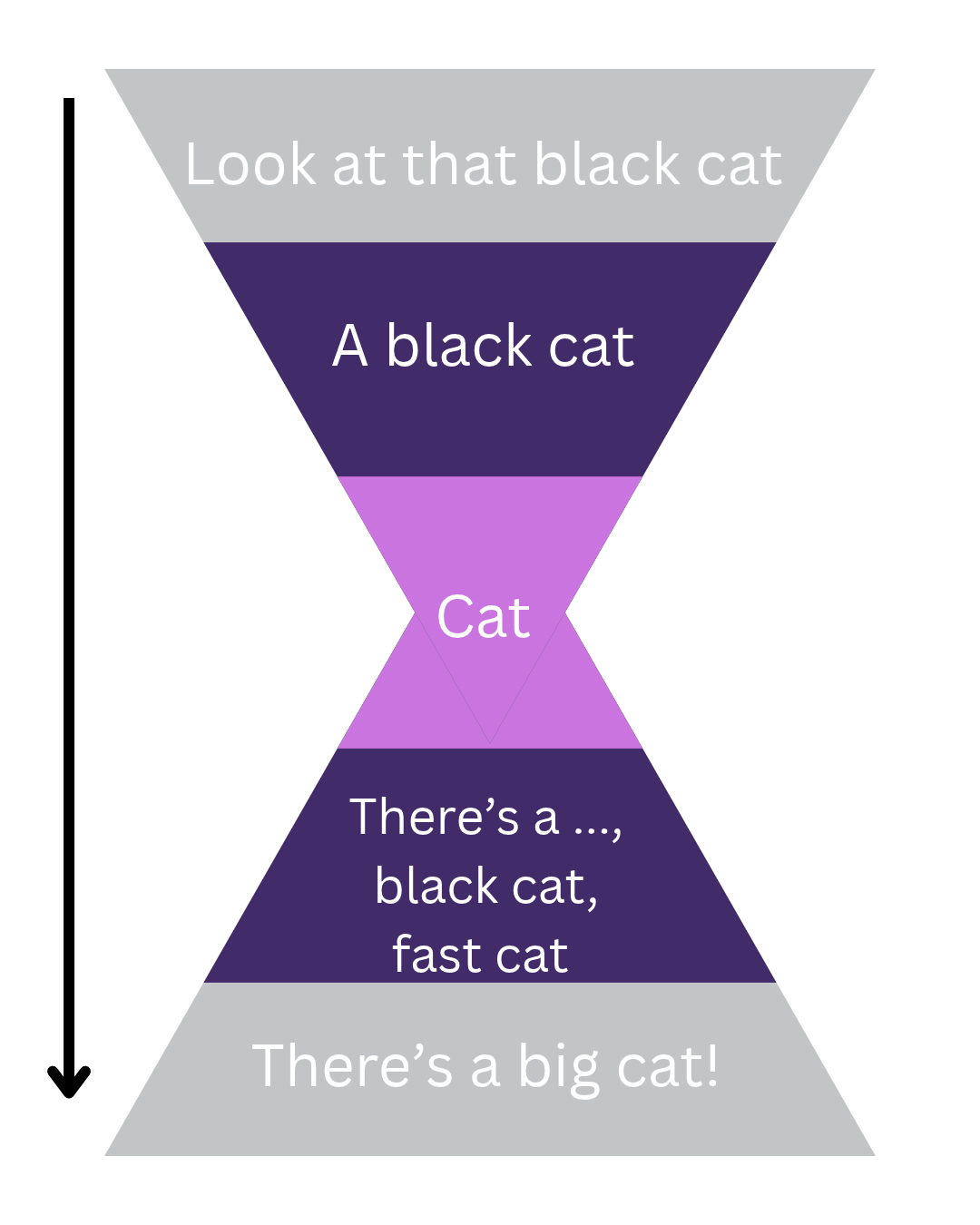
For example, a child might begin with a familiar phrase such as “Look at the monkey!” Over time, their language may include shorter phrases such as “Look monkey,” individual words such as “monkey,” and eventually new combinations such as “Big monkey!”
These examples are intended to illustrate how language might change over time. Every child’s communication journey is different, and development does not necessarily follow a fixed sequence.
One way to visualize this process is as an inverted triangle: language begins with larger chunks, which may gradually become smaller units that can be recombined into new phrases.
Some children may also imitate the rhythm, melody, or intonation of a familiar phrase before using all of its words in a flexible way.
What Is Echolalia, and Why Does It Matter?
But why does my child quote something completely unrelated to the situation?
You may notice that your child repeats phrases that seem unrelated to what is happening around them. This is often referred to as echolalia, which describes the repetition of words or phrases that someone else has said.
Echolalia can serve a meaningful purpose in communication. Rather than assuming a repeated phrase has no meaning, it can be helpful to consider what your child might be communicating through it.
There are two commonly described forms of echolalia:
Immediate echolalia
This occurs when a child repeats something shortly after hearing it.
For example:
Parent: “Do you want an apple or an orange?”
Child: “An apple or an orange?”
Your child may be repeating the options they heard rather than providing a direct answer. Observing their gestures, facial expressions, actions, and the surrounding context may help you understand what they are trying to communicate.
Delayed echolalia
This occurs when a child repeats a phrase they heard earlier. The phrase may come from a conversation, a song, a favourite show, or a familiar daily routine. It may be repeated minutes, hours, days, or even longer after the original experience.
For example, a child might repeatedly sing “Row, row, row your boat” when they are feeling frustrated or overwhelmed.
Although this phrase may not appear directly related to the situation, it could be a familiar way for the child to express an emotion, seek comfort, or communicate something they do not yet have other words for.
How Can We Understand What Our Child Is Communicating?
When a child uses a phrase that seems out of context, try approaching the situation like a detective!
Consider the following questions:
What happened before? Was your child asked to do something difficult, told that an activity was finished, or placed in an unfamiliar situation?
What was happening when they used the phrase? Were they excited, frustrated, tired, or seeking connection?
What happened afterward? Did the phrase help them communicate a need, continue an interaction, or regulate their emotions?
Looking for patterns can help you better understand the possible meaning behind your child’s words.
For example, if your child frequently sings “Row, row, row your boat” when they become upset, you might begin to notice a connection between that phrase and their emotional state.
You could then acknowledge their familiar phrase while gently modelling other ways to communicate, such as “I’m upset,” “I need help,” or “I need a break.”
The goal is not to take away a phrase that is meaningful to your child. Instead, it is to help them develop additional ways to express themselves.
How Can You Support Your Child’s Language Development at Home?
You do not need to have all the answers or know exactly what every phrase means to support your child. Small, responsive interactions throughout the day can create meaningful opportunities for communication.
Here are two strategies you can try at home.
Model Other Ways to Communicate
You can also gently model words or phrases that may help your child express the message they are trying to communicate.
For example:
Child: “Row, row, row your boat!”
Parent: “You're feeling upset. I’m here to help.”
Or, if your child appears frustrated by a difficult task, you might say, “This is hard. Help me, please.”
Keep your language natural, relevant to the situation, and easy for your child to process. There is no need to insist that they repeat your words. The goal is to provide meaningful examples of language they may draw on in the future.
Remember: communication is about more than spoken words. Gestures, facial expressions, body movements, pictures, and augmentative and alternative communication (AAC) can also support a child in expressing their needs, thoughts, and feelings.
Acknowledge What Your Child Says
Let your child know that you are listening. When they repeat a phrase, you can acknowledge it by repeating the phrase back, responding to its possible meaning, or joining them in the interaction.
For example:
Child: “Row, row, row your boat!”
Parent: “Row, row, row your boat!”
You might then continue the song together or respond to what your child appears to be communicating.
Acknowledging your child’s communication helps show them that their words and expressions have value. You do not need to correct every repeated phrase or ask them to say something differently.
Want more information into Gestalt Language Processing?
Every child has their own communication strengths, needs, and developmental journey. If you notice that your child frequently repeats phrases, has difficulty expressing their needs, or you have questions about their language development, a speech-language pathologist (SLP) can help.
An SLP can work with you to understand your child's communication patterns, identify meaningful goals, and develop practical strategies that fit into your family's everyday routines.
It is also important to remember that repeating phrases does not, on its own, mean a child is a gestalt language processor. Echolalia can occur for a variety of reasons, and children may use both chunk-based and word-by-word approaches to language learning. Research into gestalt language processing and its relationship to language development is ongoing, so individualized assessment and support are important.
At Ascend Pediatrics, we believe in meeting children where they are and building on their unique strengths. Our goal is to support meaningful communication that helps children connect with the people and world around them.
Have questions about your child's communication development? Connecting with a speech-language pathologist is a great place to start.
Do you have questions regarding your child’s speech and language development? Please reach out to info@ascendpeds.com, and they would be happy to help!